PEACE BE UNTO ALL THE TRUTHERS,SEEK KNOWLEDGE FROM CRADLE TO GRAVE

''MAKE SURE TO ALWAYS CLICK ''OLDER POSTS''AS FRONT PAGE DOES NOT CONTAIN '' FULL CONTENTS OF DAILY POSTS AND UPDATES''


Monday, June 25, 2012


Attacks to ALBA nations are connected with one another, experts say http://www.avn.info.ve/contenido/attacks-alba-nations-are-connected-one-another-experts-say
It is not an isolated fact that coup d'états have been staged in several member states of the Bolivarian Alliance for the Peoples of Our America, such as Paraguay, Honduras, Ecuador and Venezuela, said Monday member of the Venezuelan delegation to the Latin American Parliament (Parlatino), William Mundarain.Interviewed in local television, Mundarain said the events occurred in the last 10 years are responses of the United States' Department of State against sovereign nations in the continent."Latin America and the Caribbean freed from Superman's cloak. They are autonomous countries. Even nations which are not ALBA members today show a much more sovereign attitude, as in Colombia," he said.William Mundarain branded as a mischief the impeachment and removal from office of Paraguayan president Fernando Lugo because he signed the democratic protocol of the Union of South American Nations (Unasur), allowed a meeting of young people in military facilities and an alleged order to police officers to pull a group of farmers out of some lands, things he has denied."That command was given by a court at the request of the prosecutor. So, there wasn't direct responsibility of president Lugo. But if it was so, it cannot become the cause to remove him from office," Mundarain said.The express trial against Lugo had already been pre-established, "it was a premeditated attitude, in a cold-blooded manner."The expert also referred to Bolivia's case, where the right wing tries to take advantage of striking police officers to destabilize that country."None of these events are isolated. They are connected with one another. It would be naive not to think that the situation in Bolivia is also fostered by the main powers. It happened in Ecuador, Venezuela and it will continue happening."Church, coup d'états Also interviewed in the TV program, expert Xoan Noya said that the Catholic Church may have taken part on the coup against president Fernando Lugo."It seems like there was an alliance with the church because the Vatican immediately came to response in such an absurd way, recognizing a de facto government and it means they are behind it."To reject the coup, Venezuelan president Hugo Chavez ordered to recall the envoy to Paraguay and halt oil supply to that nation. In this connection, Noya said it was an accurate decision "because we are part of that international power that may revert this situation in Paraguay."With this measure, also taken by other governments in the region, the Paraguayan government will be forced to take some kind of decision because -Noya explained- in the case of the Common Market of the South (Mercosur) this South American nation would be "practically isolated.""If all countries contribute with some kind of international pressure, that isolation will be unsustainable and they'll have to take some kind of decision," said the interviewee.Xoan Noya said the rings of power or sovereignty, such as ALBA, Mercosur, the Community of Latin American and Caribbean States (CELAC) and Unasur will influence what happens in Paraguay.Besides, he said the resistance of the Paraguayan people and the South American international community may change the situation.

Venezuela withdraws envoy, cut off oil supply to Paraguay
http://www.avn.info.ve/contenido/venezuela-withdraws-envoy-cut-oil-supply-paraguay
President Hugo Chavez informed Sunday that Venezuela's ambassador to Paraguay would be withdrawn and oil supplies to that country would be halted, after a parliamentary coup d'état staged last Friday against president Fernando Lugo."We are very sorry, but we will not support that coup d'état at all, neither directly nor indirectly," said president Chavez during events to commemorate the 191 anniversary of Batalla de Carabobo, battle which that sealed Venezuela's independence and the National Army Day.Hugo Chavez said Lugo's impeachment was staged by an "obtuse bourgeoisie," described by Venezuelan foreign minister Nicolas Maduro as a faction which "does not want to dialog" because "they have already taken a decision."Last week, minister Maduro was member of a committee of the Union of South American Nations (Unasur) which traveled urgently to Asuncion to intercede on Paraguay's right-wing attempt to resume power.In this connection, president Chavez said the Venezuelan bourgeoisie does not recognize that the process against Lugo is a democratic breakdown and he reminded that the reaction was the same in those "who want to govern Venezuela when Honduran president Manuel Zelaya was overthrown and almost murdered.""Those are the bourgeoisies. They're used to humiliate people, used to walk over the Constitution and laws. There is not constitution for them, there aren't laws. But there are for us," Chavez added.The impeachment against president Lugo, Chavez said, was "express, summary, too much summary, illegal, unconstitutional.""They impeached him without proofs and also suddenly... Those things happen when bourgeoisies and the Right govern."The Venezuelan president accused Federico Franco, who was appointed as president, of using him to justify the coup, when he said Paraguay saved "from becoming Chavez's satellite.""Those are the same who became Paraguay a Yankee colony for years and backed up dictatorships, massacres, tortures and disappearances. They are the same. Paraguay's bourgeoisie," Chavez stated.

Colombian Air Force aided 2001 massacre: AUC leader
A former AUC leader claimed Colombia's Air Force lent air support to a paramilitary operation againstFARC guerrillas that killed at least 24 people in 2001.Elkin Casarrollo Posada, a high-ranking member of the AUC's Calima Bloc, said that during an AUC raid known as the El Naya massacre, he was in radio contact with Freddy Antonio Cadavid Acevedo, a Colombian solider who agreed to provide a fighter plane to ward off FARC guerrillas in the border region between the southwestern departments of Cauca and Valle del Cauca.The 15-day paramilitary operation took place in April 2001 in the village of El Naya and resulted in the death of between 24 and 200 civilians, according to various estimates.Similarly, the Prosecutor General's Office received information from Eladio Vivero, who was kidnapped by the AUC, that a commander called for air support from Colombia's Air Force in June 2001 and received two helicopters to help fight guerrilla soliders. He also alleged that after the helicopters fired on FARC rebels, the paramilitary leader was told to withdraw from the area by an army officer before another nearby military company advanced on their position.An arrest warrant was issued June 15 for Captain Mauricio Zambrano for his suspected role in the planning of the El Naya massacre after he failed to show up for questioning.AUC member Armando Lugo, alias “El Cabezon,” one of the paramilitaries on trial for the massacre, said in 2010 that Zambrano allowed him to access a military base near El Naya, where combat supplies used by the paramilitaries were allegedly obtained.


US Lawsuit vs. Staff of Mexican Presidential Candidate Peña Nieto Reveals Apparent Violation of US Law...No Foreign Agent Complied With Requirement to Register in US on Behalf of the PRI Candidate’s Campaign http://www.narconews.com/Issue67/article4597.html
A civil lawsuit filed this month in US court against several Mexican companies and three top officials from the campaign of Mexican presidential candidate Enrique Peña Nieto alleges the parties engaged in a conspiracy to convert campaign funds derived from narco-traffickers to their own personal use by employing a scheme to defraud a US company.The lawsuit also alleges that Peña Nieto campaign operatives threatened a plaintiff that the money “was funded from companies owned by drug cartels and it was further stated that Jose Aquino [owner of Frontera Television Network] must be very careful not to make any noise or his life is in danger.”


The complaint charges the defendants with two counts of “racketeering” under the RICO (Racketeering Influenced Corrupt Organization”) laws, plus charges of Fraud, Breach of Fiduciary Duty and Negligent Representation. It seeks $100 million dollars in punitive damages from the defendants.Narco News today makes the court documents and evidence available for review by citizens and journalists of both countries, and internationally.In the extensive court documents are two contracts:The first was signed in Mexico on November 28, 2011 and agrees to pay $15 million dollar to the US company Frontera Television Network, represented by José Aquino, and is signed by representatives of two Mexican companies, GM Global Media, represented by Mario Ignacio Moran Jimenez, and Jiramos, represented by Alejandro Carillo Garza.
A second contract, which replaced the initial pact, that is evidence in the lawsuit was for more than $50 million dollars in advertising and publicity services, signed on January 6, 2012 between two Mexican companies and a US media company. It details an ambitious advertising and public relations campaign on US television, radio, Internet and print media, plus billboards and other media that would reach Spanish-speaking Mexicans living in the United States. The company Intelimedia S.A. DE C.V., represented by the signature of José Aquino on the contract, would serve as an ad agency and public relations manager for a Mexican company called Servicios Integrales al Sector Agropecuario, represented by the signature of Alejandro Ramírez González. Multi-million dollar categories ($25 million for television advertising alone) totaling some $56 million were detailed in four sections of the contract, each page initialed by the signatories, according “Exhibit A” in the lawsuit.The common thread in both contracts is the signature of José Aquino, on behalf of Frontera Television Network in the first contract and Intelimedia in the second.Aquino’s Frontera Television Network filed the lawsuit on June 7 in the US District Court of Central California against the aforementioned companies plus three high officials in the presidential campaign of Enrique Peña Nieto: Erwin Lino, the candidate’s personal secretary, David López, the candidate’s communications director and Roberto Calleja, spokesman for the Institutional Revolutionary Party (PRI, in its Spanish initials), which has nominated Peña Nieto as its presidential candidate in the July 1 election.One of the Court documents in the Frontera litigation mentions Pena Nieto specifically, indicating that he “may have a direct, pecuniary [monetary] interest in the outcome of this case.”The court pleadings allege that the $56 million media promotion contract was breached and the money never delivered to Frontera and its affiliates, but instead the funds were diverted to the personal use of Pena Nieto’s operatives.
Did Peña Nieto Violate US Law?
What is not mentioned in the litigation is a US law known as the Foreign Agents Registration Act, which requires agents representing foreign entities (such as political parties like the PRI) to register with and make specific disclosures to the US Department of Justice.The DOJ Web site says the following about FARA:
The purpose of FARA is to insure that the U.S. Government and the people of the United States are informed of the source of information (propaganda) and the identity of persons attempting to influence U.S. public opinion, policy, and laws. In 1938, FARA was Congress’ response to the large number of German propaganda agents in the pre-WWII U.S.Failure to comply with FARA, the DOJ Web site states, is punishable, upon conviction, “by a fine of not more than $10,000 or by imprisonment for not more than five years.”Narco News checked the online filing database for FARA registrants and also contacted theDOJ FARA office to determine whether any of the parties central to the Frontera lawsuit had registered under the act. The online database check revealed no such filings and a spokesman for the FARA office indicated he also was unaware of the litigation — and even asked for the case number for the Frontera lawsuit.Based on a reading of the FARA statute, it would appear a case could be made that, at a minimum, Frontera Television Network, as well as the companies alleged to have links to Pena Nieto’s presidential campaign and who were signatories to the media propaganda contract (included as an exhibit in the lawsuit) should have registered under FARA — assuming the allegations in the court pleadings are truthful.Narco News contacted Frontera’s attorney, Maxwell C. Agha, but he was unavailable for comment on the FARA requirements.The catch in all of this, however, is the veracity of the alleged contract included in the litigation, and whether it can be proven that PRI Party operatives were behind it.A FARA office spokesman says in order for FARA to be invoked, it has to be shown that the businesses involved in such an alleged contract “were under the direction and control of a foreign government or political party.”Determining the truth of the matter will be at the heart of that litigation, but clearly the stakes for Pena Nieto could be quite high should a jury rule in Frontera’s favor in the litigation, given it may well open the door to an inquiry from DOJ as to whether Pena Nieto and/or his staff members violated a US criminal law (FARA) — not a good outcome should Pena Nieto be elected president, and one that could provide US officials additional influence, personally and legally, over a possible President Peña Nieto when it comes to pressuring Mexican officials to hand over sovereign decisions to the neighbor up north.
Explosive Charges
The explosive charges were made public three weeks before the July 1 Mexican presidential election and are being vehemently denied by Pena Nieto, whose spokesman contends, according to a story in the Mexican publication Proceso, that he is, in fact, the one who is the target of a fraud perpetrated by the US company and its representatives.The Proceso story states that Pena Nieto —the 2012 Mexican presidential candidate for the Institutional Revolutionary Party (PRI, in its Spanish initials) — has called on Mexico’s Attorney General to prosecute the plaintiffs for having brought the lawsuit in the United States.The central charge in the lawsuit, filed in US federal court in Riverside, Calif., is that several companies and individuals linked to the Pena Nieto presidential bid diverted campaign funds obtained from “drug cartels” to their own “personal use.”To cover up the alleged money laundering scheme, pleadings in the lawsuit claim, the Pena Nieto operatives contracted with Nevada –based Frontera Television Network LLP — and later one of its affiliates — to design a media campaign to promote Pena Nieto’s presidential run in US-based media. Many Mexicans have cable TV and Internet connections and watch Univision and CNN Español and even English-language channels. In addition, Mexicans living along the Mexican/US border, in places such as Juarez, Tijuana or Nuevo Laredo, watch TV broadcasts from US stations.The supposed truth to be revealed through the litigation, according to the Frontera lawsuit, is that two Mexican companies and their representatives inked a multi-million contract in November 2011 with Frontera Television Network on behalf of PRI officials “David Lopes, Erwin Lino … and Roberto Calleja….”The contract called for Frontera to design a “political advertising” campaign for Pena Nieto that would make use of US “magazines, radio, television, Internet and social networks.”That initial contract was replaced in early January 2012 with a similar pact that, according to the litigation, included as signatories an affiliate of Frontera, called Intelimedia, and a company created by the defendants, called Servicios Integrales Al Sector Agropecuario S.C.. But, the pleadings assert, that contract also was breached and the same diversion scheme remained in place.
From Frontera’s complaint in the lawsuit:
… Each of [the defendants] refused to pay for the advertising campaign for PRIcandidate Enrique Pena Nieto. Defendants … concealed the fact that they converted the [$56 million in] advertising funds for their own private and personal use.… The United States for PRI campaign for the political presidential candidacy of Enrique Pena Nieto continues to operate in Mexico, and there is a continuing threat of criminal activity until the United States for PRI campaign for the political presidential candidacy of Enrique Pena Nieto Enterprise has accomplished its goal of converting campaign funds for it’s own private and personal use including funds contributed by drug cartels.… Frontera Television Network LLP through it’s authorized agents contacted the PRI officials David Lopez, Erwin Lino, Roberto Callejas, Alfredo Carrillo, and Jose Carrillo, and Plaintiff Frontera Television Network LLP through it’s authorized agents were threaten by it being stated that the money that was originated was funded from companies owned by drug cartels and it was further stated that Jose Aquino [owner of Frontera Television Network] must be very careful not to make any noise or his life is in danger.The plaintiff, Frontera Television Network, is seeking compensatory damages in an amount to be determined at trial plus $100 million in punitive damages, as well as an injunction “prohibiting any disbursements of any [Pena Nieto] campaign funds pending the hearing on this matter,” the legal pleadings state.The defendants, including the officials allegedly representing Pena Nieto, have not yet filed a response with the US court.Court Documents of public interest:– Text of lawsuit complaint seeking $100 million in damages (English). Notice of Interest for Enrique Peña Nieto (English).
“Exhibit A”: Multi-million dollar contracts for media campaign in US (Spanish).

Bullets and Blood: The High Price of Anti-Mining Resistance in San José del Progreso

On the evening of June 16, a red Dodge Ram pickup truck drove by spraying two anti-mining activists with bullets. They survived but two leaders of the Coalition of United Peoples of the Ocotlán Valley (CPUVO), which opposes the Canadian Fortuna Silver mine in Oaxaca, were killed in similar incidents. Why the mounting violence?
Read more →

Iran Media Use 2012

The Broadcast Board of Governors, which is in charge of US  propaganda broadcasts, and Gallup teamed up to do a report on "Iran Media Use 2012"
"Despite living in a restrictive media environment, where the internet and satellite television are restricted, Iranians are relatively well-connected, the survey found:Ninety percent of households had at least one mobile phone, 67 percent had a computer and 26 percent had a satellite dish. That put the prevalence of such technology in Iran roughly on par with that in Turkey, less well-connected than the rich Persian Gulf states, but more so than North African and Middle Eastern countries like Egypt, Syria and Jordan.
 
When it comes to news, 49 percent of IRIB’s viewers rated its programming as “very trustworthy,” while 40 percent said it was “somewhat trustworthy.” The fact that so many respondents expressed less than total satisfaction with IRIB is significant, given that they were speaking on the phone to a foreign pollster, and likely were self-censoring, said William Bell, the BBG's director of research. “If people were fearful about talking about state television, it's striking that half of them would say it's not very trustworthy,” Bell said.
 
The perceived trustworthiness of foreign broadcasting, however, was not dramatically different, according to the same survey. Of four international news sources (which the BBG did not publicly name), the number of respondents rating them either very or somewhat trustworthy ranged from 65 percent to 80 percent.
 
Iranian news consumers are cynical about all sources of news, Bell said. While they appreciate international broadcasters' lack of censorship and the airing of entertainment programs not shown by Iranian broadcasters, they also tend to believe that international broadcasters have a political agenda and they resent criticism from outside, he said.
 

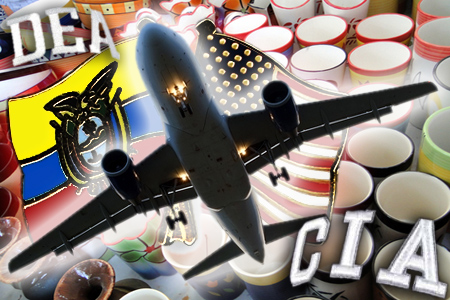
Who Might Have Planted Drugs into Ecuadoran Diplomatic Pouch and Why. An Attempt to Unravel the Plot  http://www.tiwy.com/news.phtml?id=236

Unexpectedly, the Italian police demanded to open Ecuador’s diplomatic suitcases during a routine customs procedure in Milan. Staff from TNT EXPRESS WORLDWIDE SPAIN, the company responsible for the shipment, asked the Italian officers to pay attention to the fact that the seals placed on the suitcases by the Ecuadoran ministry of foreign affairs were intact but refrained from protesting. Similarly, Ecuadoran diplomats, who had a feeling that a provocation was brewing, reacted softly in a hope to prevent escalation. In the meantime, the police agents opened a total of 10 boxes with diplomatic labeling, from all of which they extracted plastic jars with double walls, and immediately voiced suspicion that the space in between was filled with liquid cocaine.

Reports about the incident – the sensational news that the Italian police caught Ecuadoran diplomats red-handed and discovered 80 jars loaded with 40 kg of cocaine, thus neutralizing a whole channel of drug supply from South America to Europe - momentarily leaked to the media. It was clear that the sting was launched based on serious a priori information about where the narcotics were to be found and how they were disguised, but the Italian police shared no details. The inescapable impression was that the perpetrators had been under surveillance from the outset, and it took the Ecuadoran foreign ministry time and efforts to piece together the picture of what had happened.

The plastic jars, along with other theater artifacts, were being delivered on the requests from Cristian Loor, director of an Ecuadoran troupe which planned to stage the Ruga la Tortuga show in Milan. Loor explained that he asked to have the belongings shipped via diplomatic channels to avoid the customs hassle and pledged that the show would serve to draw tourists to Ecuador and to advance the country’s environment protection agenda. The promotional jars carried the troupe’s logo and pictures of turtles unique to the Galapagos Islands. The jars, mostly Chinese-made, with coolant poured into the space between the double walls to keep beverages cold, are commonly used in Ecuador. The mystery in the case is who stuffed the jars with cocaine and what forces masterminded the plot.
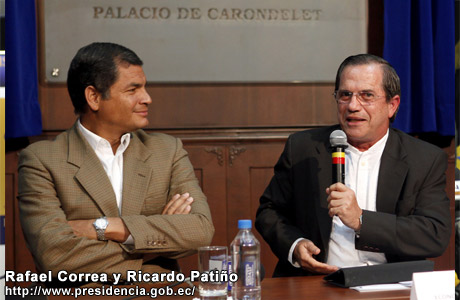
Ecuador's diplomacy chief Ricardo Patino said in response that, while it would be up to the investigation to unearth the whole truth, the idea of concealing drugs in diplomatic mail which is on a regular basis inspected by police with dogs trained to locate narcotics either was reckless or grew out of far-reaching intentions, the likely motivation being to undermined the reputation of Ecuador. Evidently, the above was a reference to the objectives pursued by the U.S. intelligence community and propaganda machine, considering that R. Correa’s government steadily occupies a line on Washington’s list of enemies on pars with that of H. Chavez. The U.S. Administration is allergic to Ecuador’s ambitious social policies, push for real – not nominal – independence, and allegiance to the ALBA bloc, and was completely outraged when president Correa ruled to close a U.S. military base in the country and ordered out U.S. ambassador Heather M. Hodges, together with a bunch of CIA and DEA agents, on charges of meddling in the domestic affairs of Ecuador, inspiring a coup, and massively infusing money into opposition NGOs and groups.

It might seem for a time that the relations between the U.S. and Ecuador had reached a standstill phase, but the explanation is purely circumstantial: at the moment, Washington’s new envoy to Quito Adam Namm is in the process of getting a grip on what he is facing at the new destination. The contours of the future are an easy guess: Washington’s broad offensive against the government of R. Correa will roll on. The Ecuadoran leader warned over the past several months that “hostile forces” are scheming to overthrow him and made it clear that he would not give up without a fight. Respect for Correa is rising internationally and as of today he ranks among the cohort of defiant Latin American leaders centered around Venezuela’s H. Chavez. When the latter had to tone down his activities due to health problems, Correa emerged as the continent’s political champion when he called for a sweeping reform, if not the abolition, of the Organization of American States, enthusiastically urged his peers to scrap the Inter-American Treaty of Reciprocal Assistance, and pressed for equipping UNASUR with its own defense subsystem.

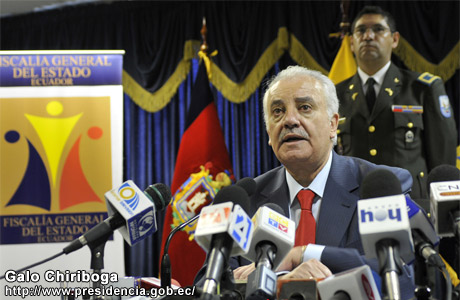
Angering Washington no less, Ecuadoran foreign minister Ricardo Patino is determined to put the initiatives into practice. Patino’s characterization of the recent drug scandal left no doubt that he assessed it as a provocation pulled off by the U.S. intelligence community with the assistance from its agents in drug cartels. An Ecuadoran probe showed no violations by the diplomatic agency’s staff which packaged the shipment sent to Milan. Moreover, it is an established fact that the suitcases passed the inspection procedure involving specially trained dogs. Ecuador’s prosecutor general Galo Chiriboga said a probe was opened into the possible complicity of the TNT carrier in drug trafficking. The police of Ecuador considers it highly probable that drugs were put into the luggage at some point of the Guayaquil-Brussels-Madrid-Milan route via which the diplomatic suitcases were flown by a TNT aircraft.
One of the effects of the loudly advertised war on terror is that these days airline companies have to operate under tight oversight exercised by the West’s intelligence community. The companies’ own security services interlock with the CIA, DEA, and their European analogs, meaning that those are presented with ample opportunities to further their agendas – in the spheres of drug trafficking prevention or international politics - using the cooperation.

It should be also taken into account that opponents of Correa’s regime occasionally hold positions in the Ecuadoran foreign ministry, consulates, etc. The CIA worked for decades to build a network of agents in the institution and could easily forge seals or signatures as needed to put cocaine into the diplomatic suitcases. The jars worth a total of around $300 could be bought in Quito, and, as Ecuadoran technical experts verified, replacing the coolant with the drug substance must have taken minutes. The Ecuadoran police is looking into the case and a number of hypotheses on who coordinated and implemented the operation are on the table. It did not evade watchers in Ecuador in this connection that Timothy Zuniga-Brown who was Deputy Chief of the U.S. Mission in the country since 2011 had a lengthy record of serving in the U.S. embassies’ divisions which fight drug trafficking across the Bahamas and therefore could easily contribute experience to the operation. Experts see Luis G. Moreno, Deputy Chief of the U.S. Embassy in Madrid, as a likely coordinator in the plot. Moreno’s personal history of fight against drug trafficking includes Nicaragua, Peru, Columbia (two missions), Panama, Haiti, and Mexico. The former and present-day colonial powers have common interests in Latin America, and Spanish intelligence agencies are known to be in close touch with the CIA and DEA, especially in dealing with the populist regimes.

Minister Patino says that the questions arising in the context of the drug story remain unanswered so far and that in some cases similar problems take decades to resolve. It is, however, immediately obvious what interests were pursued when the scandal erupted. Seven people, among them Redroban Quevedo who owns a restaurant frequented by Ecuadorans resident in Italy, and troupe director Cristian Loor, are currently in custody. Supposedly, the list further includes U.S. citizen Jean Paul Flores – he was not mentioned in the latest accounts, but those refer to a Cuban national who might be the same Flores, with the personal profile edited due to political reasons.

The pro-U.S. media repeatedly feature pictures of Quevedo and Loor chatting with Ecuadoran leader’s sister Pierina Correa. Implicating the family of the president of Ecuador could be the end goal, while Pierina Correa holds that she routinely met with many Ecuadoran emigrants worldwide, had no specific links to the above two, and would readily talk to the police over the matter.

Ecuadorian opposition and media figures notorious for their ideological connections to and financial transactions with the U.S. Embassy promptly seized the chance to demand a deeper inquiry into the scandal. A rally with slogans calling for the ouster of minister Patino and throwing around chalk dust which symbolized cocaine convened in front of the Ecuadoran foreign ministry. A fairly typical CIA and DEA scenario is unfolding, and that in itself is the best illustration of the objectives behind the scandal involving Ecuador and the jars with cocaine.
Obama's War on Democracy in Latin America http://globalresearch.ca/index.php?context=va&aid=31587
by Stephen Lendman


In June 2009, Obama orchestrated Honduran President Manuel Zelaya's ouster. A US supported fascist despot replaced him. For good reason, Honduras is called the murder capital of the world. Independent journalists are killed. So are protesters for democratic change. After its calamitous January 2010 earthquake, Obama militarized Haiti, plundered it freely, opposed Jean-Bertrand Aristide's return, orchestrated the nation's rigged elections, and prohibited the emergence of democracy.On September 30, 2010, his attempt to oust Ecuador's Rafael Correa failed. Coup plotters shut down airports, blocked highways, burned tires, and roughed up the president.They also took over an airbase, parliament, and Quito streets. They acted on the pretext of a law restructuring police benefits. Ignored was that Correa doubled their wages. Obama's fingerprints were all over the scheme to oust a business-friendly leader who fell short of a neoliberal perfection. If Correa grants Julian Assange amnesty, perhaps his long knives won't fail next time.In the interim, he added another democrat to his trophy collection. On June 22, he plunged a dagger into Paraguayan democracy. Parliamentary impeachment was his weapon of choice.A former Roman Catholic Bishop, Fernando Lugo was elected president in August 2008. Noted liberation theologian/philosopher/author Leonardo Boff attended his inauguration.He said it was "an extremely happy moment." He called Lugo a "true bishop of liberation. We are celebrating the rise to power of one more liberator of Latin American."Called both "the Bishop of the Poor" and "the Red Bishop," his election ushered in hope for change. Ordained in 1977, he worked as an indigenous community missionary until 1982.
He spent 10 years studying at the Vatican. He was appointed Paraguay's Divine Word head. In 1994, he became Bishop of the Paraguayan San Pedro Department.Three of his brothers were exiled. Conservative Paraguayan Catholic leaders pressured him to resign because he supported landless family settlements on large latifundio estates.On Christmas day 2006, he announced his presidential candidacy. Popular support made him a threat to Colorado Party rule. In September 2007, he formed a multi-party opposition coalition. He registered as a Christian Democrat Party (PDC) candidate. He ran as the Patriotic Alliance for Change (APC) nominee.Winning nearly 41% of the vote, he failed to gain an absolute majority. Colorado's Blanca Ovelar got 31%. He pledged a government "characterized by honesty and not by corruption." He called for "unity" and extended "a very special invitation to the entire political class, to all without exception" to participate in his governmentColorado leaders vowed to regain power as soon as possible. With others on the far right, it controls parliament.Lugo said "Latin America is living a different moment." His inauguration ended six decades of right wing Colorado rule. Paraguay's population is around seven million. It's one of South America's poorest countries. Nearly half the population lives on less than $2 a day. Unemployment or underemployment runs almost 40%.Social inequality is among Latin America's highest. Powerful interests run the country. One man alone can't change things. Governing as a centrist, he tried, but now he's gone. He called himself a proponent of "socially responsible" capitalism. Washington considers him a closet communist.
He vowed to be a uniter, not a divider. "I will not be a Paraguayan Morales," he said. He promised "a middle path between Chavez and Lula."From 1947 - 1989, mostly junta power ran Paraguay. General Alfredo Stroessner was in charge from August 1954 - February 1989. After falling out of favor with Washington, General Andres Rodriguez's coup ousted him.In May 1993, Colorado's Juan Carlos Wasmosy became Paraguay's first civilian president in four decades. Lugo's ouster reestablished hardline neoliberal rule. Right wing parliamentarians assure it.After a five-hour trial, 39 senators voted to remove him. Washington controlled things behind the scenes. Ahead of proceedings, Venezuela's Foreign Minister Nicolas Maduro traveled to Asuncion with 11 other regional foreign ministers. He denounced them as a "new type of coup." He called it a "truly shameful act..."Lugo didn't attend. He watched on television. His lawyers spoke on his behalf. They got virtually no preparation time. Their request for 18 days was denied. Doing so violated Paraguay's constitution.Their arguments on behalf of Lugo fell on deaf ears. Proceedings were rigged to convict. Orders came from el norte.Ahead of his ouster, Venezuela's Union of South American Nations (UNASUR) Secretary-General Ali Rodriguez denounced the attempted coup.He said "UNASUR’s greatest concern is the legitimate exercise of democracy, and within that, that there be a guiding principal of the administration of justice and conditions, (that's) absolutely indispensable."Following the coup, ALBA (Bolivarian Alliance of the Americas) countries condemned it. Lugo attorneys got one day's notice and two hours to defend him. Charges against him were spurious.Ahead of them in mid-June, clashes between landless peasants and police left 17 dead. Lugo named a new interior minister and national police chief.The confrontations followed weeks of peasants occupying wealthy latifundista land. They called it illegally acquired public land. The combination was pretext to act. Parliamentary palace coup proceedings followed.
Charges brought included signing a Mercosur Southern common market Protocol for Democracy, allowing a military installation youth meeting, clashes described above, deaths resulting from them, and failure to capture leftist guerillas. The indictment said evidence supporting charges wasn't necessary. Lugo was guilty by accusation. Ousting him was prearranged. Latin American democracy sustained a body blow.Lugo called his removal "a parliamentary coup against the will of the people." He called the new government illegitimate. He said democracy must be restored.ALBA members expressed solidarity. Liberal Party member Federico Franco replaced him. He served as Lugo's vice president. His neoliberal advocacy is business friendly. Recognition wasn't extended.He's extrajudicially forming a new government. He promised to respect big money's private property and honor Paraguay's foreign commitments. He meant those benefitting elite interests. He asked other regional leaders not to call him a pariah for spurning the rights of impoverished Paraguayans desperate for help to survive.Venezuelan Vice President Elias Jaua blamed Washington and elitist Paraguayans for what happened. He denounced efforts to weaken revolutionary Latin American change, saying:"The battle of the Paraguayan people is that of the Venezuelans, and we are committed to thwart this new attempt by the oligarchies and imperialism as we did in Venezuela in 2002...."He added that regional popular struggles are about "letting imperialism know that our Latin America is no longer their backyard."At the same time, ending its last vestiges takes time. Lugo's ouster set things back. It's for regional campesinos to regain lost ground. It's crucial they continue struggling against neoliberalism's death grip. It's that or perish. There is no other choice.
[ed notes: This was no surprise,i had posted this on my blog last year!!! CIA in Paraguay, or How to Get Rid of a President - Tiwy.com
Paraguay: Obama's Second Latin American Coup
http://axisoflogic.com/artman/publish/Article_64652.shtml


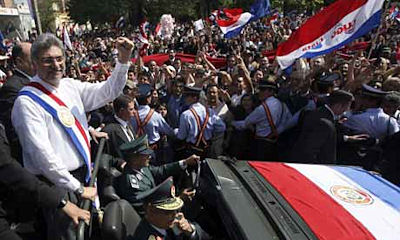
Paraguay's president, former Catholic bishop Fernando Lugo, greeting the crowd after his swearing-in ceremony in Asunción, in 2008. Photograph: Ivan Alvarado/Reuters

The recent coup against Paraguay's democratically elected president is not only a blow to democracy, but an attack against the working and poor population that supported and elected President Fernando Lugo, whom they see as a bulwark against the wealthy elite who've dominated the country for decades.
The U.S. mainstream media and politicians are not calling the events in Paraguay a coup, since the president is being "legally impeached" by the elite-dominated Paraguayan Congress. But as economist Mark Weisbrot explains in the Guardian:
"The Congress of Paraguay is trying to oust the president, Fernando Lugo, by means of an impeachment proceeding for which he was given less than 24 hours to prepare and only two hours to present a defense. It appears that a decision to convict him has already been written...The main trigger for the impeachment is an armed clash between peasants fighting for land rights with police...But this violent confrontation is merely a pretext, as it is clear that the president had no responsibility for what happened. Nor have Lugo's opponents presented any evidence for their charges in today's ‘trial.’ President Lugo proposed an investigation into the incident; the opposition was not interested, preferring their rigged judicial proceedings."
What was the real reason the right-wing Paraguay Senate wanted to expel their democratically elected president? Another article by the Guardian makes this clear:
"The president was also tried on four other charges: that he improperly allowed leftist parties to hold a political meeting in an army base in 2009; that he allowed about 3,000 squatters [landless peasants] to illegally invade a large Brazilian-owned soybean farm; that his government failed to capture members of a [leftist] guerrilla group, the Paraguayan People's Army... and that he signed an international [leftist] protocol without properly submitting it to congress for approval."
The article adds that the president's former political allies were "...upset after he gave a majority of cabinet ministry posts to leftist allies, and handed a minority to the moderates...The political split had become sharply clear as Lugo publicly acknowledged recently that he would support leftist candidates in future elections."
It's obvious that the President's real crimes are that he chose to ally himself more closely with Paraguay's left, which in reality means the working and poor masses of the country, who, like other Latin American countries, choose socialism as their form of political expression.
Although Paraguay's elite lost control of the presidency when Lugo was elected, they used their stranglehold over the Senate to reverse the gains made by Paraguay's poor. This is similar to the situation in Egypt: when the old regime of the wealthy elite lost their president/dictator, they used their control of the judiciary in an attempt to reverse the gains of the revolution.
Is it fair to blame the Obama administration for the recent coup in Paraguay? Yes, but it takes an introductory lesson on U.S. - Latin American relations to understand why. Paraguay's right wing - a tiny wealthy elite - has a long-standing relationship with the United States, which has backed dictatorships for decades in the country - a common pattern in most Latin American countries.
The United States promotes the interests of the wealthy of these mostly-poor countries, and in turn, these elite-run countries are obedient to the pro-corporate foreign policy of the United States (The Open Veins of Latin America is an excellent book that outlines the history).
Paraguay's elite is incapable of acting so boldly without first consulting the United States, since neighboring countries are overwhelmingly hostile to such an act because they fear a U.S.-backed coup in their own countries.
Paraguay's elite has only the military for internal support, which for decades has been funded and trained by the United States. President Lugo did not fully sever the U.S. military's links to his country. According to Wikipedia, "The U.S. Department of Defense (DOD) provides technical assistance and training to help modernize and professionalize the [Paraguay]military..."
In short, it is not remotely possible for Paraguay's elite to act without assurance from the United States that it would continue to receive U.S. political and financial support; the elite now needs a steady flow of guns and tanks to defend itself from the poor of Paraguay.
The Latin American countries surrounding Paraguay denounced the events as they unfolded and made an emergency trip to the country in an attempt to stop them. What was the Obama administration's response? Business Week explains:
"As Paraguay’s Senate conducted the impeachment trial, the U.S. State Department had said that it was watching the situation closely."
“We understand that Paraguay’s Senate has voted to impeach President Lugo,” said Darla Jordan, a spokeswoman for the U.S. State Department’s Bureau of Western Hemisphere Affairs...“We urge all Paraguayans to act peacefully, with calm and responsibility, in the spirit of Paraguay’s democratic principles.”
Obama might as well have said: "We support the right-wing coup against the elected president of Paraguay.” Watching a crime against democracy happen - even if it is "watched closely" - and failing to denounce it makes one complicit in the act. The State Department's carefully crafted words are meant to give implicit support to the new illegal regime in Paraguay.
Obama acted as he did because Lugo turned left, away from corporate interests, towards Paraguay's poor. Lugo had also more closely aligned himself with regional governments which had worked towards economic independence from the United States. Most importantly perhaps is that, in 2009, President Lugo forbid the building of a planned U.S. military base in Paraguay.
What was the response of Paraguay's working and poor people to their new dictatorship? They amassed outside of the Congress and were attacked by riot police and water cannons. It is unlikely that they will sit on their hands during this episode, since President Lugo had raised their hopes of having a more humane existence.
President Lugo has unfortunately given his opponents an advantage by accepting the rulings that he himself called a coup, allowing himself to be replaced by a Senate-appointed president. But Paraguay's working and poor people will act with more boldness, in line with the social movements across Latin America that have struck heavy blows against the power of their wealthy elite.
President Obama's devious actions towards Paraguay reaffirm which side of the wealth divide he stands on. His first coup in Honduras sparked the outrage of the entire hemisphere; this one will confirm to Latin Americans that neither Republicans nor Democrats care anything about democracy.

Wednesday, June 20, 2012

Turkish party: CIA, Mossad responsible for Syria massacres
IslaM Times - A Turkish political party says the US Central Intelligence Agency (CIA) and Israel’s spy agency Mossad are responsible for massacres in Syria.
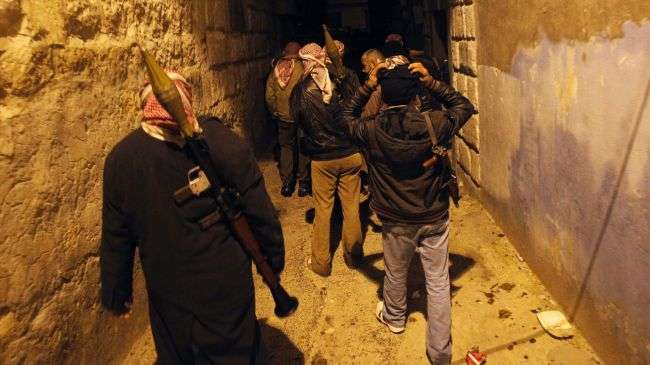
Syrian rebels walk in an alley in the city of Idlib in northwestern Syria on February 8, 2012.
A Turkish paper quoted the Deputy Chief of Turkey’s Felicity Party, Temel Karamollaoglu as saying, “Not only the Syrian crisis will not be solved, but also it will lead to civil war.”On the one hand, western countries claim that they do not support armed conflicts in Syria, but, on the other, the US is obviously making attempts to arm the Syrian rebels, who are fighting the Middle Eastern country’s government, he said.“Due to having common interests in Syria, the US, Israel, and the EU make no attempt to stop bloodshed in the country.”However -- Russia and China have rejected military intervention in Syria because they witnessed the outcome of the West’s war in Libya, Karamollaoglu added. Following the foreign intervention in Libya, which led to the death of the country’s former dictator Muammar Gaddafi, thousands of innocent people were killed by the Western military alliance of NATO’s aerial bombardments, he said.
Syria has been experiencing unrest since mid-March 2011. The violence has claimed the lives of hundreds of people, including many security forces.Damascus blames ‘outlaws, saboteurs, and armed terrorist groups’ for the unrest, asserting that it is being orchestrated from abroad.The West and the Syrian opposition, however, accuse the government of killing protesters.
Syrian opposition leaders seek EU support for overthrow of Assad regime http://www.europarl.europa.eu/news/en/headlines/content/20120615STO46953/html/Syrian-opposition-leaders-seek-EU-support-for-overthrow-of-Assad-regime
EU diplomacy should help to overthrow the Assad regime, Syrian opposition leaders told the EP's foreign affairs committee on 19 June. They spoke out in favour of a peaceful solution and shared a vision of a free and democratic post-Assad Syria. We spoke with dissidents Haitham al-Maleh and Kamal al-Labwani about how change can be achieved in the country.
The fall of the regime
Mr al-Labwani said the fall of the regime would be a necessary first step towards change. "After that we can start negotiations, we can compose a national government and we can implement the Kofi Annan peace plan, but first we need Bashar al-Assad to leave." To achieve that, internal protests should be coupled with diplomatic pressure from the international community.
Mr al-Maleh, a democracy activist and former judge, said: "the regime is finished... a thing of the past." During the hearing, he drew a parallel with the sudden collapse of the Soviet regime: "The Syrian regime is rotten to the core and can fall as a house of cards."
The opposition
Some of the MEPs criticised the fragmented nature of the Syrian opposition during the committee meeting. Mr al-Maleh responded that there may be differences among opposition groups on some issues but this is only natural as "there is no opposition in the world that is unified". However, there is unity on the objective "to bring the regime down, to finish with it and build a new democratic country with separation of powers and equality of people before law".Mr al-Labwani agreed on the main objectives: "We need freedom, we need democracy, we need elections for a new president. We need to make sure dictatorship will not reappear in a new form."
Role of the international community 
During the meeting, opposition leaders emphasised the importance of humanitarian aid to alleviate the population's plight. They also called for more pressure on Russia to lift its resistance to UN Security Council-backed sanctions against the regime. Meanwhile, things might be changing on the ground. "I heard that yesterday Russians started leaving Syria," said Mr al-Maleh, adding: "Something will happen very soon but it is important that the international community should react quickly."

[ED NOTES:HAITHEM AL-MALEH,NAME SOUNDS FAMILIAR..OH YES THIS FRAUD,A SOROS PUPPET..  http://thenakedfacts.blogspot.com/2012/06/brittains-subversive-tactics-on-regime.html
Maleh's most recent arrest was on 14 October 2009, a day after giving an interview on 'Panorama',[8] a political analysis show onBarada TV, a London-based satellite channel associated with the Syrian opposition and allegedly funded by the U.S. government'' [9]

[ED NOTES:NOW,WHO IS  ''Kamal al-Labwani''http://www.freedomtocreate.com/content/view/78
Dr. Kamal al-Labwani Finalist of the 2008
Freedom to Create Imprisoned Artist Prize


[ED NOTE;WHOS BEHIND THIS PRIZE? http://en.wikipedia.org/wiki/Freedom_to_Create_Prize

Founder

Richard F. Chandler is a New Zealand-born businessman worth $3.1 billion in March 2010, according to Forbes. He was formerly CEO of the Sovereign group of companies, in partnership with his brother, Christopher Chandler. From 1986 to 2006, Sovereign invested in companies and governments in Asia, Africa, Latin America and Eastern Europe, and in industries including telecommunications, electric utilities, steel, oil and gas, banking and oil refining.[1]
[ED NOTES:BACK TO DR KAMAL..  A Syrian court charged him with “communicating with a foreign country and inciting it to initiate aggression against Syria.” Labwani had visited the United States and Europe in the fall of 2005 where he had met with government officials, journalists and human rights organizationson November 8, 2005 upon his return from a two-month trip to Europe and the United States. During his trip, he appeared on the pan-Arab Al-Mustaqilla and Al-Hurra television networks where he called on the Syrian government to respect fundamental freedoms and human rights.http://www.hrw.org/en/news/2007/05/10/syria-peaceful-activist-gets-12-years-hard-labor

[ED NOTES;HE WAS IMPRISONED FOR CONSPIRING AND MEETING WITH US OFFICIALS WITHOUT ANY AUTHORITY TO DO SO,EXCEPT FOR WHAT HIS TRUE INTENTIONS WERE,TO CONSPIRE..AND APPEARING ON CIA/PENTAGON BACKED,SPONSORED/FUNDED  AL-HURRA TV? HES A CONSPIRATOR ,PERIOD.
Alhurra (or Al Hurra), is an Arabic-language American satellite TV channel based in Springfield, Virigina, financed by the U.S. government, and "aimed at viewers in the Middle East.In February 2005, Reuters reported on plans to broadcast Alhurra to Muslim communities in Europe, as part of the Bush administration's "new escalation of its information war against Islamic extremism." Al Hurra-Al Who?: Haven't heard? We're Free, They're Not!
US counters bad publicity of Iraqi prisoner abuse through al-Hurra TV
Alhurra - the Zionist 'Arab' news network | empirestrikesblack